
Estimated Reading Time: 6–7 minutes
Introduction
Many funding companies entering online lead buying assume pre-settlement leads behave like traditional loan or finance leads. That assumption often leads to frustration, mismatched expectations, and disappointing ROI.
In reality, pre-settlement leads are fundamentally different—in how they are generated, qualified, verified, and converted. Understanding these differences is critical for evaluating lead quality correctly and scaling profitably.
What Are Pre-Settlement Leads?
Pre-settlement leads are inquiries from plaintiffs with active legal cases who are seeking financial relief while their lawsuit is still pending.
Unlike loan leads, these prospects are:
- Case-dependent, not credit-dependent
- Subject to legal and liability review
- Required to involve their attorney
- Not guaranteed to qualify after evaluation
A pre-settlement lead represents an opportunity for review—not an approved funding decision.
How Loan Leads Work (And Why Expectations Differ)
Traditional loan leads typically operate in a very different environment.
Loan leads are usually:
- Credit-driven and income-based
- Processed through automated decision systems
- High-speed and high-volume
As a result, many loan buyers expect:
- Same-day or instant approvals
- Minimal third-party involvement
- Clear and predictable qualification rules
Pre-settlement leads do not follow this model—and treating them the same way leads to incorrect conclusions about quality.
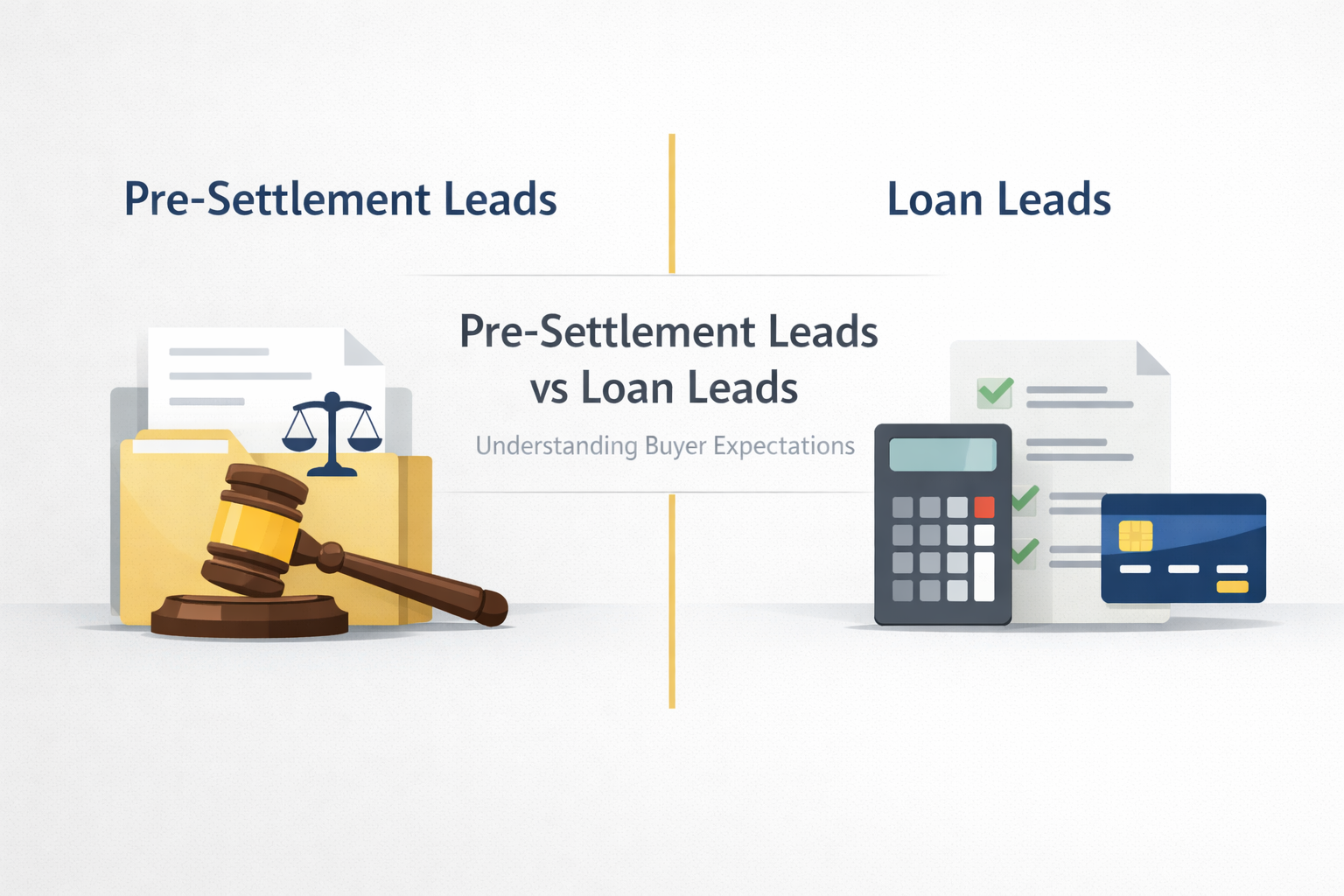
Pre-Settlement Leads vs Loan Leads
| Aspect | Pre-Settlement Leads | Loan Leads |
|---|---|---|
| Qualification Basis | Case strength & liability | Credit & income |
| Attorney Involvement | Mandatory | None |
| Approval Speed | Variable | Fast |
| Conversion Timeline | Longer | Short |
| Guaranteed Outcome | No | Often yes |
| Volume Consistency | Case-driven | Traffic-driven |
Why Pre-Settlement Leads Cannot Be “Instant”
Even high-quality pre-settlement leads require several verification steps:
- Attorney contact and consent
- Case documentation review
- Liability and risk assessment
- Internal funding policy checks
This means:
- Real-time lead delivery does not equal instant funding
- Some leads will be declined after proper review
- Conversion depends heavily on follow-up and legal coordination
These delays are normal characteristics of the funding process—not indicators of poor lead quality.
What Makes a Pre-Settlement Lead Valuable?
A strong pre-settlement lead typically includes:
- Confirmation of an active legal case
- Relevant case type (auto accident, PI, etc.)
- A clear and legitimate funding need
- Willingness to involve their attorney
- Accurate and reachable contact information
However, no lead provider can guarantee funding approval—just as no advertising platform can guarantee a sale.
How to Evaluate ROI Correctly
Successful funding companies measure performance using:
- Cost per funded case (not cost per lead)
- Approval ratios over time
- Follow-up efficiency
- Attorney responsiveness
Judging pre-settlement leads by speed alone—especially when compared to loan leads—leads to flawed ROI analysis.
Final Takeaway
Pre-settlement leads are not loan leads, and they should never be treated as such.
Funding companies that understand:
- Legal timelines
- Case-based risk evaluation
- Attorney dependency
are the ones that achieve consistent, sustainable ROI.
If you’re buying pre-settlement leads, success comes from alignment—not automation.