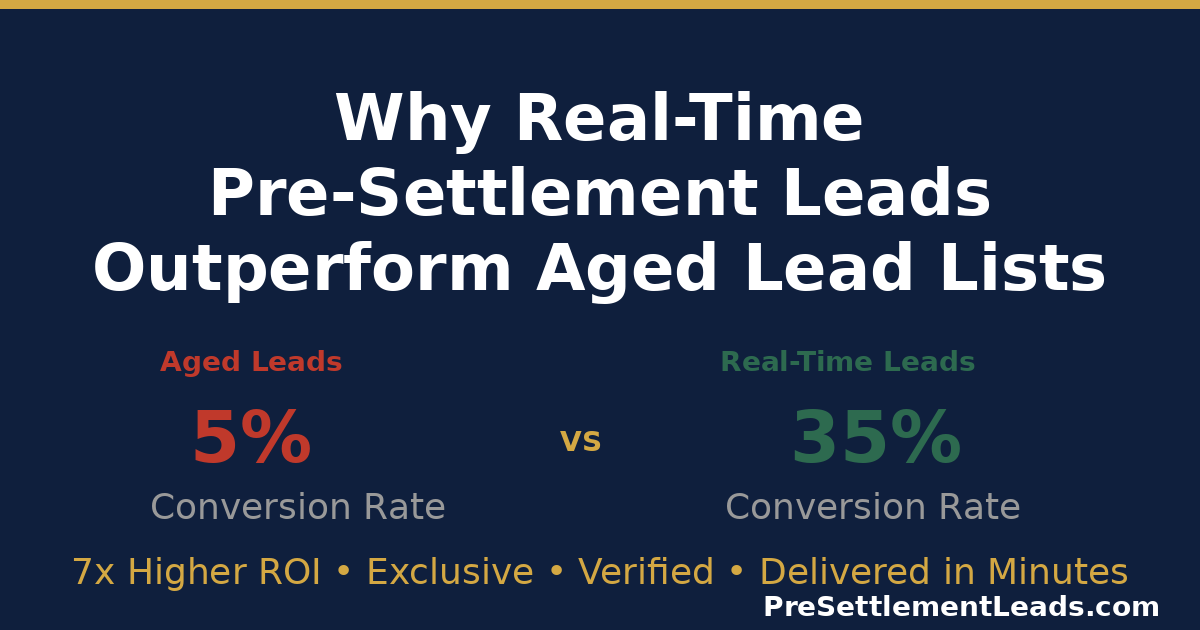
Why Real-Time Pre-Settlement Leads Outperform Aged Lead Lists

Why Real-Time Pre-Settlement Leads Outperform Aged Lead Lists

When law firms and funding companies invest in pre-settlement leads, they’re making a bet on future revenue. But not all leads are created equal. The difference between a real-time lead delivered within minutes of qualification and an aged lead that’s been sitting in a database for days or weeks can mean the difference between a 40% conversion rate and a 5% conversion rate.

If you’re still purchasing aged lead lists or working with providers who can’t guarantee immediate delivery, you’re leaving money on the table. Here’s why real-time leads consistently outperform their aged counterparts—and what that means for your bottom line.


The Window of Opportunity Is Measured in Minutes, Not Days

When a plaintiff reaches out seeking pre-settlement funding, they’re in crisis mode. They need money now—medical bills are piling up, rent is due, or they’re facing eviction. This isn’t a casual inquiry; it’s a financial emergency.

Research across the legal services industry consistently shows that the first responder wins. A Harvard Business Review study found that companies who contacted leads within 5 minutes were 100 times more likely to convert than those who waited 30 minutes or more.

In pre-settlement funding, this effect is even more pronounced:

  • Within 5 minutes: You’re having a conversation with someone who still remembers filling out the form and is actively waiting for a response
  • Within 1 hour: The plaintiff has likely contacted 2-3 competitors
  • Within 24 hours: They’ve either funded with someone else or decided to wait on their settlement
  • After 48+ hours: The lead is essentially dead—the crisis has either been resolved or the plaintiff has moved on

When you purchase aged leads, you’re entering the race after your competitors have already crossed the finish line.

Aged Leads = Aged Intent

A lead generated today represents current, active intent. The plaintiff who filled out a pre-settlement funding application this morning is experiencing financial pressure right now. Their need is immediate and their motivation to move forward is high.

Now consider what happens to that same lead after it sits in a database for a week:

  1. The crisis may have resolved itself — A family member loaned them money, their attorney advanced costs, or they took out a credit card
  2. They’ve already funded with a competitor — Someone else responded faster and closed the deal
  3. The circumstances have changed — Their case settled, they went back to work, or their financial situation stabilized
  4. They’ve experienced “form fatigue” — After filling out multiple funding applications and receiving countless calls, they’re burned out and unresponsive

Every day that passes between lead generation and contact decreases the likelihood of conversion. By day 7, you’re not really calling a lead—you’re calling a stranger who barely remembers why they filled out that form in the first place.

The Competitive Disadvantage of Shared/Aged Leads

Most aged lead lists operate on a shared model: the same lead is sold to multiple buyers to maximize the provider’s revenue per lead. This creates a perfect storm of poor performance:

You’re the 5th, 10th, or 20th call they’ve received.

By the time you reach out, the plaintiff has already:

  • Spoken with multiple funding companies
  • Received different rate quotes (creating price comparison paralysis)
  • Developed skepticism about the legitimacy of the calls
  • Possibly been burned by a less reputable provider

You have no competitive intelligence.

You don’t know:

  • How many other companies have this lead
  • What offers they’ve already received
  • Which competitors are currently in negotiations
  • Whether the lead has already funded

Your brand suffers.

When plaintiffs receive 15 calls about the same inquiry, they don’t think “these funding companies are really responsive”—they think “I must have signed up for spam.”

▶ Key Insight

The higher upfront cost per lead is irrelevant when the conversion rate is 7x higher. What matters is cost per funded case, not cost per lead.

Real-Time Leads: The Competitive Advantage

When you receive a lead within minutes of qualification, everything changes:

1. First-Mover Advantage

You’re often the first and only call they receive. There’s no price comparison, no competitive pressure, no skepticism. It’s a genuine conversation between a plaintiff who needs help and a funding professional who can provide it.

2. Higher Trust Levels

When you call someone 3 minutes after they submitted a form, they’re impressed by your responsiveness. It signals:

  • You’re a legitimate, professional operation
  • You take their situation seriously
  • You have the infrastructure to help quickly

This trust advantage carries through the entire conversation and makes closing significantly easier.

3. Accurate Information

The plaintiff’s circumstances haven’t changed since they filled out the form. Their case status, financial need, and attorney relationship are all exactly as described. There’s no “I actually settled last week” or “My situation has changed.”

4. Emotional Momentum

Financial stress creates urgency. When a plaintiff is in crisis mode and you call immediately, they’re primed to move forward. Wait a week and that emotional momentum dissipates—they’ve adapted to their circumstances or found another solution.

The Math: Real-Time vs. Aged Lead ROI

Let’s run the numbers on a typical scenario for a mid-sized funding company:

Aged Lead List Scenario

  • Cost per lead: $25
  • Leads purchased: 100
  • Contact rate: 40% (many numbers disconnected, changed, or don’t answer)
  • Conversion rate: 5% (of those contacted)
  • Funded cases: 2
  • Average funding amount: $5,000
  • Average profit margin: 25%
  • Revenue: $2,500 (2 × $5,000 × 25%)
  • Lead cost: $2,500 (100 × $25)
  • Net profit: $0

You break even at best, and that’s assuming optimistic conversion rates.

Real-Time Exclusive Lead Scenario

  • Cost per lead: $75
  • Leads purchased: 100
  • Contact rate: 95% (fresh numbers, expecting your call)
  • Conversion rate: 35% (of those contacted)
  • Funded cases: 33
  • Average funding amount: $5,000
  • Average profit margin: 25%
  • Revenue: $41,250 (33 × $5,000 × 25%)
  • Lead cost: $7,500 (100 × $75)
  • Net profit: $33,750

Same number of leads purchased, but 33x more funded cases and $33,750 more profit.

Metric Aged Leads Real-Time Leads
Cost per funded case $1,250 $227
Contact rate 40% 95%
Conversion rate 5% 35%
Funded cases (from 100 leads) 2 33

What Makes a Lead “Real-Time”?

Not all providers who claim “real-time” delivery actually deliver on that promise. Here’s what true real-time lead generation looks like:

  • Immediate delivery: Lead reaches you within 5 minutes of qualification
  • Exclusive ownership: You’re the only buyer receiving this lead
  • Verified before delivery: Basic qualification completed before it hits your system
  • Direct connection: Lead came from your traffic sources, not recycled databases
  • Fresh contact information: Phone number and email verified within the last hour

If your provider can’t guarantee all five of these elements, you’re not getting true real-time leads.

The Hidden Costs of Aged Leads

Beyond the obvious conversion rate issues, aged leads create operational inefficiencies that drain resources:

  • Wasted rep time: Your sales team spends hours chasing disconnected numbers and unresponsive contacts instead of having productive conversations.
  • CRM pollution: Your database fills with junk data—bad numbers, duplicates, and “leads” who have no idea why you’re calling.
  • Morale impact: Nothing burns out sales reps faster than calling 50 leads and reaching 5 people, none of whom remember inquiring.
  • Compliance risk: Calling people on aged lists increases the likelihood of TCPA violations, especially if the lead has requested no further contact from previous callers.
  • Reputation damage: When you’re the 12th company to call about the same inquiry, you’re not building your brand—you’re actively harming it.

Reality Check: A rep who previously needed to call 100 aged leads to fund 5 cases can now call 30 real-time leads and fund 10 cases. The math changes everything.

Questions to Ask Your Lead Provider

If you’re evaluating lead providers or considering making a switch, ask these questions:

  1. How long between lead generation and delivery?
    Acceptable answer: “Under 5 minutes, usually 2-3 minutes.”
  2. Is this lead sold to anyone else?
    Acceptable answer: “No, it’s 100% exclusive to you.”
  3. How do you verify lead quality before delivery?
    Look for specific verification steps, not vague promises of “quality.”
  4. What’s your average contact rate?
    Acceptable answer: “90%+” (if it’s lower, the leads aren’t truly real-time)
  5. Can I see data on conversion rates from other clients?
    Reputable providers have benchmarks they can share.
  6. What happens if a lead is bad?
    Look for clear policies on refunds/credits for invalid leads.

The Bottom Line

In pre-settlement funding, speed is everything. The plaintiff in crisis doesn’t have time to wait for callbacks or compare offers across multiple providers. They need help now, and they’ll fund with whoever responds first with a professional, empathetic approach.

Aged lead lists might be cheaper per lead, but they’re dramatically more expensive per funded case. When you factor in conversion rates, rep efficiency, and operational overhead, real-time exclusive leads aren’t just better—they’re the only economically rational choice for serious funding companies and law firms.

The question isn’t whether you can afford to switch to real-time leads. The question is whether you can afford not to.

Ready to Experience the Real-Time Advantage?

We deliver exclusive, verified, real-time leads to law firms and funding companies nationwide. Our proprietary qualification process ensures you’re only paying for leads that meet your exact criteria—delivered within minutes, not days.

Schedule Your Consultation →

About Pre-Settlement Leads
We specialize in generating exclusive, real-time pre-settlement funding leads for law firms and funding companies. Our verification process ensures that every lead delivered meets strict quality standards, and our real-time delivery guarantees you reach plaintiffs when they’re most motivated to move forward.
SIMILAR ARTICLES

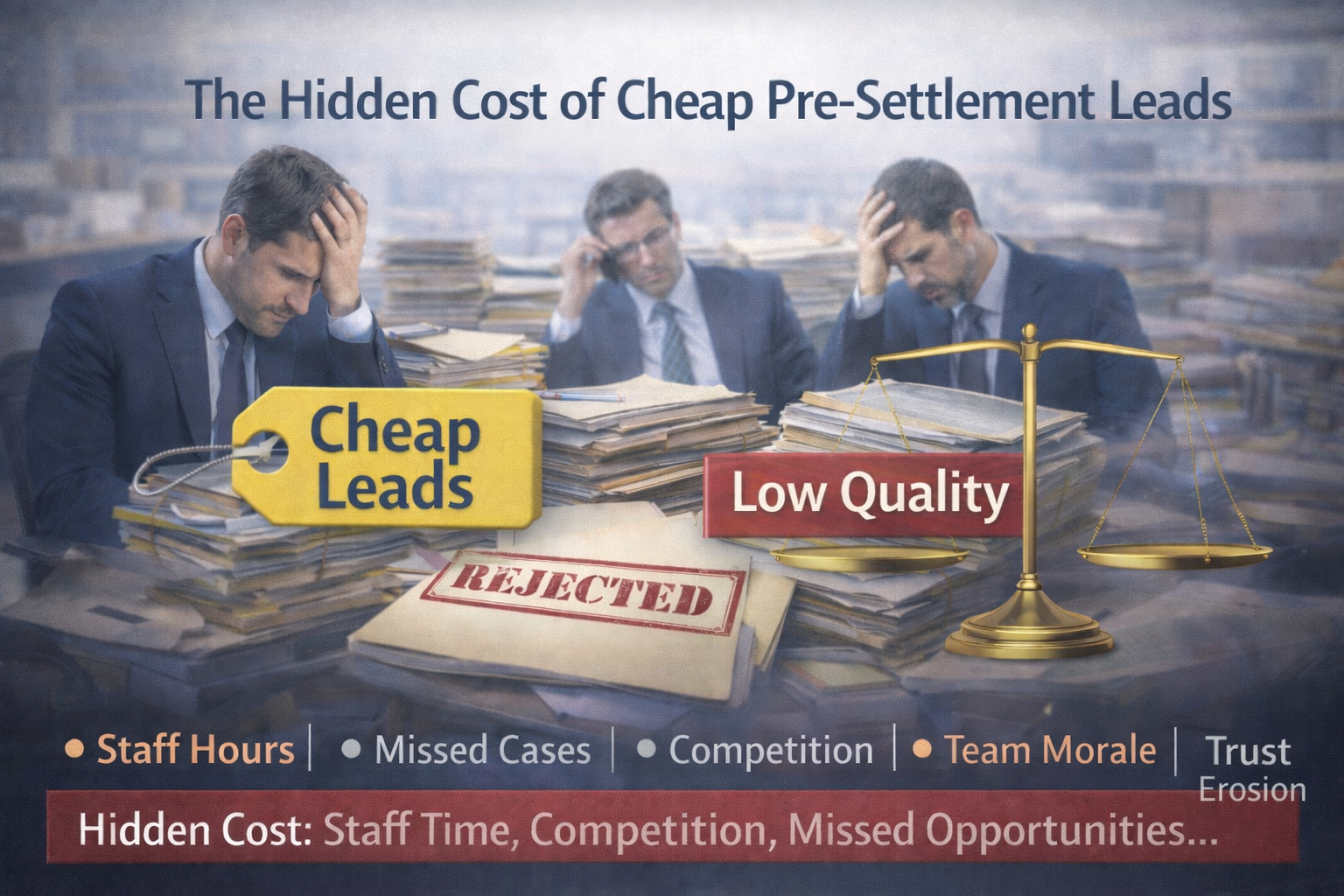
The Hidden Cost of Cheap Pre-Settlement Leads

The Hidden Cost of Cheap Pre-Settlement Leads

Estimated Reading Time: 6–7 minutes


Introduction

Cheap pre-settlement leads can look attractive.
Lower upfront cost.
Higher volume.
Faster delivery.

But the real question isn’t:
“How much does the lead cost?”
It’s:
“What does it cost to process a bad lead?”

This article explores the hidden operational and financial costs of low-priced, poorly filtered pre-settlement leads—and why focusing on price alone often reduces ROI.


The Illusion of Low Cost

A $30 shared lead may seem cheaper than a $90 exclusive one.
But pricing only reflects delivery, not:

  • Staff time spent reviewing
  • Follow-up effort
  • Intake rejection rates
  • Opportunity cost of missed qualified cases

Cheap leads are only cheap before you process them.


1️⃣ Staff Time Is the Real Expense

When intake teams receive poorly screened leads, they must:

  • Verify injury type
  • Confirm treatment status
  • Clarify representation
  • Check jurisdiction

If most leads require rejection, your team spends hours on non-revenue work.
Time is a cost multiplier.


2️⃣ Low Intent Leads Reduce Conversion Morale

Repeatedly contacting unqualified or unready prospects leads to:

  • Lower team motivation
  • Slower response times
  • Decreased confidence in marketing channels

Even good leads suffer when intake teams are overwhelmed by bad ones.


3️⃣ Competition Erodes Claimant Trust

Cheap leads are often shared widely.
When claimants receive multiple calls:

  • They disengage
  • They stop answering
  • They delay decisions

Over-competition damages lead quality—even if the original inquiry was valid.


4️⃣ Opportunity Cost Is Often Ignored

Every minute spent on an unqualified lead is a minute not spent on:

  • Reviewing documentation
  • Following up with serious prospects
  • Moving viable cases forward

Cheap volume can crowd out higher-value opportunities.


5️⃣ Filtering Reduces Waste Before Delivery

Higher-priced leads often reflect:

  • Advanced filtering
  • Case stage qualification
  • Jurisdiction matching
  • Distribution clarity

You’re not paying more for the contact.
You’re paying less for the waste.


Why Price-Only Comparison Is Misleading

When comparing lead providers, ask:

  • What percentage of leads reach evaluation stage?
  • How many are rejected due to stage or mismatch?
  • How much intake time is spent per lead?
  • Are leads shared or exclusive?

True ROI comes from efficiency, not just volume.


A Better Way to Measure Lead Value

Instead of measuring:
Cost per lead

Measure:
Cost per viable case opportunity

This single shift often changes how professionals evaluate lead sources.


Final Thoughts

Cheap pre-settlement leads can look efficient on paper.
But when filtering is weak and qualification is shallow, the hidden costs accumulate:

  • Lost time
  • Lower morale
  • Reduced conversion
  • Operational noise

In pre-settlement acquisition, sustainable ROI usually comes from alignment, not discounting.


Explore a More Controlled Approach to Pre-Settlement Leads

Instead of optimizing for lowest price, consider optimizing for lowest waste.
PreSettlementLeads.com focuses on filtering, transparency, and buyer-defined criteria—so you evaluate fewer, better-aligned inquiries.

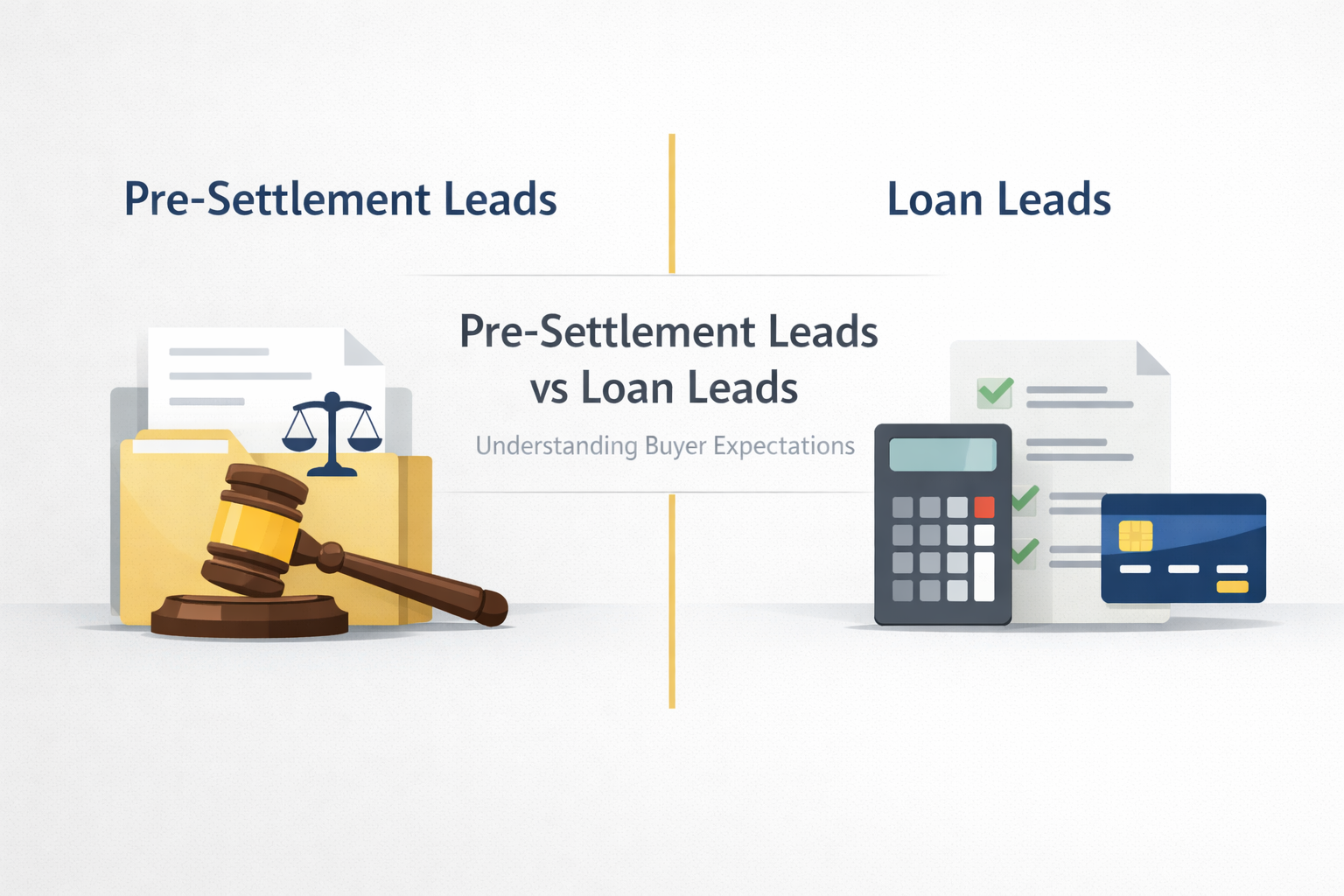
Pre-Settlement Leads vs Loan Leads: Why They Are Not the Same

Pre-Settlement Leads vs Loan Leads: Why They Are Not the Same

Estimated Reading Time: 6–7 minutes


Introduction

Many funding companies entering online lead buying assume pre-settlement leads behave like traditional loan or finance leads. That assumption often leads to frustration, mismatched expectations, and disappointing ROI.

In reality, pre-settlement leads are fundamentally different—in how they are generated, qualified, verified, and converted. Understanding these differences is critical for evaluating lead quality correctly and scaling profitably.


What Are Pre-Settlement Leads?

Pre-settlement leads are inquiries from plaintiffs with active legal cases who are seeking financial relief while their lawsuit is still pending.

Unlike loan leads, these prospects are:

  • Case-dependent, not credit-dependent
  • Subject to legal and liability review
  • Required to involve their attorney
  • Not guaranteed to qualify after evaluation

A pre-settlement lead represents an opportunity for review—not an approved funding decision.


How Loan Leads Work (And Why Expectations Differ)

Traditional loan leads typically operate in a very different environment.

Loan leads are usually:

  • Credit-driven and income-based
  • Processed through automated decision systems
  • High-speed and high-volume

As a result, many loan buyers expect:

  • Same-day or instant approvals
  • Minimal third-party involvement
  • Clear and predictable qualification rules

Pre-settlement leads do not follow this model—and treating them the same way leads to incorrect conclusions about quality.


Pre-Settlement Leads vs Loan Leads

Aspect Pre-Settlement Leads Loan Leads
Qualification Basis Case strength & liability Credit & income
Attorney Involvement Mandatory None
Approval Speed Variable Fast
Conversion Timeline Longer Short
Guaranteed Outcome No Often yes
Volume Consistency Case-driven Traffic-driven

Why Pre-Settlement Leads Cannot Be “Instant”

Even high-quality pre-settlement leads require several verification steps:

  • Attorney contact and consent
  • Case documentation review
  • Liability and risk assessment
  • Internal funding policy checks

This means:

  • Real-time lead delivery does not equal instant funding
  • Some leads will be declined after proper review
  • Conversion depends heavily on follow-up and legal coordination

These delays are normal characteristics of the funding process—not indicators of poor lead quality.


What Makes a Pre-Settlement Lead Valuable?

A strong pre-settlement lead typically includes:

  • Confirmation of an active legal case
  • Relevant case type (auto accident, PI, etc.)
  • A clear and legitimate funding need
  • Willingness to involve their attorney
  • Accurate and reachable contact information

However, no lead provider can guarantee funding approval—just as no advertising platform can guarantee a sale.


How to Evaluate ROI Correctly

Successful funding companies measure performance using:

  • Cost per funded case (not cost per lead)
  • Approval ratios over time
  • Follow-up efficiency
  • Attorney responsiveness

Judging pre-settlement leads by speed alone—especially when compared to loan leads—leads to flawed ROI analysis.


Final Takeaway

Pre-settlement leads are not loan leads, and they should never be treated as such.

Funding companies that understand:

  • Legal timelines
  • Case-based risk evaluation
  • Attorney dependency

are the ones that achieve consistent, sustainable ROI.

If you’re buying pre-settlement leads, success comes from alignment—not automation.

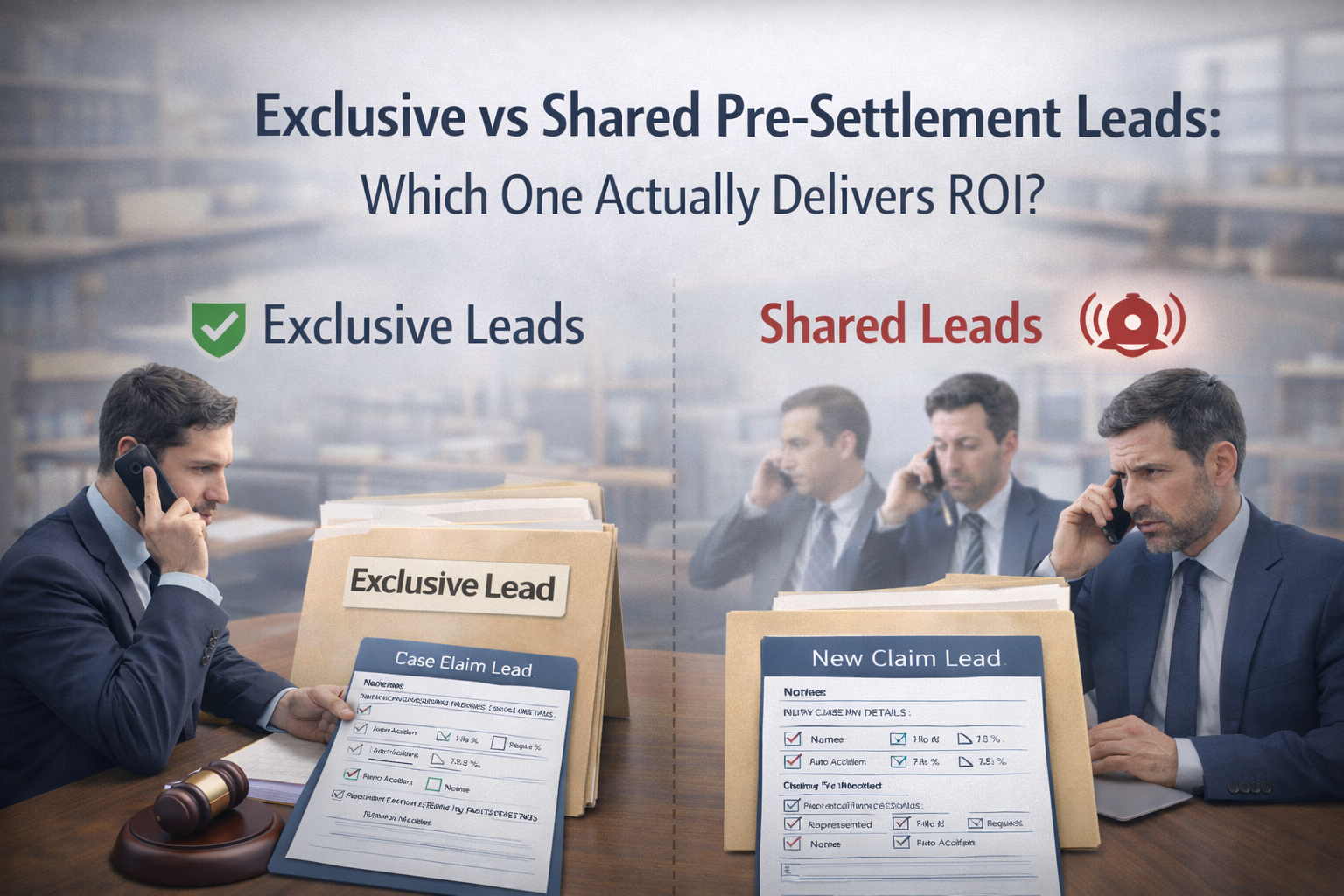
Exclusive vs Shared Pre-Settlement Leads: Which One Actually Delivers ROI?

Exclusive vs Shared Pre-Settlement Leads: Which One Actually Delivers ROI?

Estimated Reading Time: 6–7 minutes


Introduction

One of the most common questions attorneys and pre-settlement funding firms ask is simple:
Should we buy exclusive leads or shared leads?
The answer isn’t about hype or pricing—it’s about process, expectations, and return on effort. This article breaks down how exclusive and shared pre-settlement leads actually work, where each model fits, and which one tends to deliver better ROI over time.


What Are Shared Pre-Settlement Leads?

Shared leads are inquiries delivered to multiple buyers at the same time.
How shared leads typically work:

  • One claimant submits an inquiry
  • The same details are sent to several firms
  • Buyers compete on response time and follow-up

Common advantages:

  • Lower upfront cost
  • Higher volume availability

Common challenges:

  • Speed becomes more important than evaluation
  • Claimants receive multiple calls
  • Trust drops quickly
  • Qualification quality often suffers

Shared leads turn intake into a race, not a review process.


What Are Exclusive Pre-Settlement Leads?

Exclusive leads are delivered to one buyer only, based on predefined criteria.
How exclusivity works:

  • Buyer selects filters (case type, stage, location, etc.)
  • Only matching inquiries are delivered
  • No competing outreach from other buyers

Common advantages:

  • Clear ownership of the inquiry
  • Better claimant experience
  • More time for proper evaluation
  • Predictable intake workflow

Exclusivity supports deliberate case assessment, not rushed contact.


The ROI Difference Isn’t Just About Cost

Many buyers compare exclusive vs shared leads purely on price.
That comparison is incomplete.
ROI is influenced by:

  • Staff time spent per lead
  • Follow-up efficiency
  • Case relevance
  • Claimant engagement

A cheaper shared lead that consumes hours of staff time can cost more than a higher-priced exclusive lead that fits immediately.


Where Shared Leads Can Make Sense

Shared leads may be suitable when:

  • You have a high-capacity intake team
  • Speed-based outreach is part of your model
  • You are testing a new market
  • Volume matters more than precision

They work best when expectations are realistic and processes are optimized for competition.


Where Exclusive Leads Perform Better

Exclusive leads tend to perform better when:

  • Case evaluation requires documentation review
  • Jurisdiction or criteria are strict
  • You value claimant experience
  • Intake teams prioritize quality over speed

For most pre-settlement evaluations, control beats competition.


The Hidden Cost of Over-Competition

When claimants receive multiple calls:

  • Confusion increases
  • Responsiveness drops
  • Trust erodes

This affects everyone involved—not just one buyer.
Exclusivity reduces noise and creates a more professional intake experience.


Choosing the Right Model for Your Operation

Instead of asking:

  • “Which leads are cheaper?”

Ask:

  • How much time does my team spend per lead?
  • How many leads reach evaluation-ready stage?
  • How predictable is my intake workflow?
  • How important is claimant experience?

The answers usually point toward better-aligned lead delivery, not just more leads.


Final Thoughts

Exclusive and shared pre-settlement leads serve different purposes—but they don’t deliver the same results.
For firms focused on efficiency, clarity, and sustainable growth, exclusivity often provides stronger ROI—not because it guarantees outcomes, but because it supports better process.


Explore a More Controlled Approach to Pre-Settlement Leads

Instead of competing for the same inquiry, consider a model where lead delivery aligns with your evaluation criteria from the start.
PreSettlementLeads.com focuses on buyer-defined filters and transparent distribution—so you know exactly how and why a lead reaches you.

⚖️ Better control. Better evaluation. Better ROI.

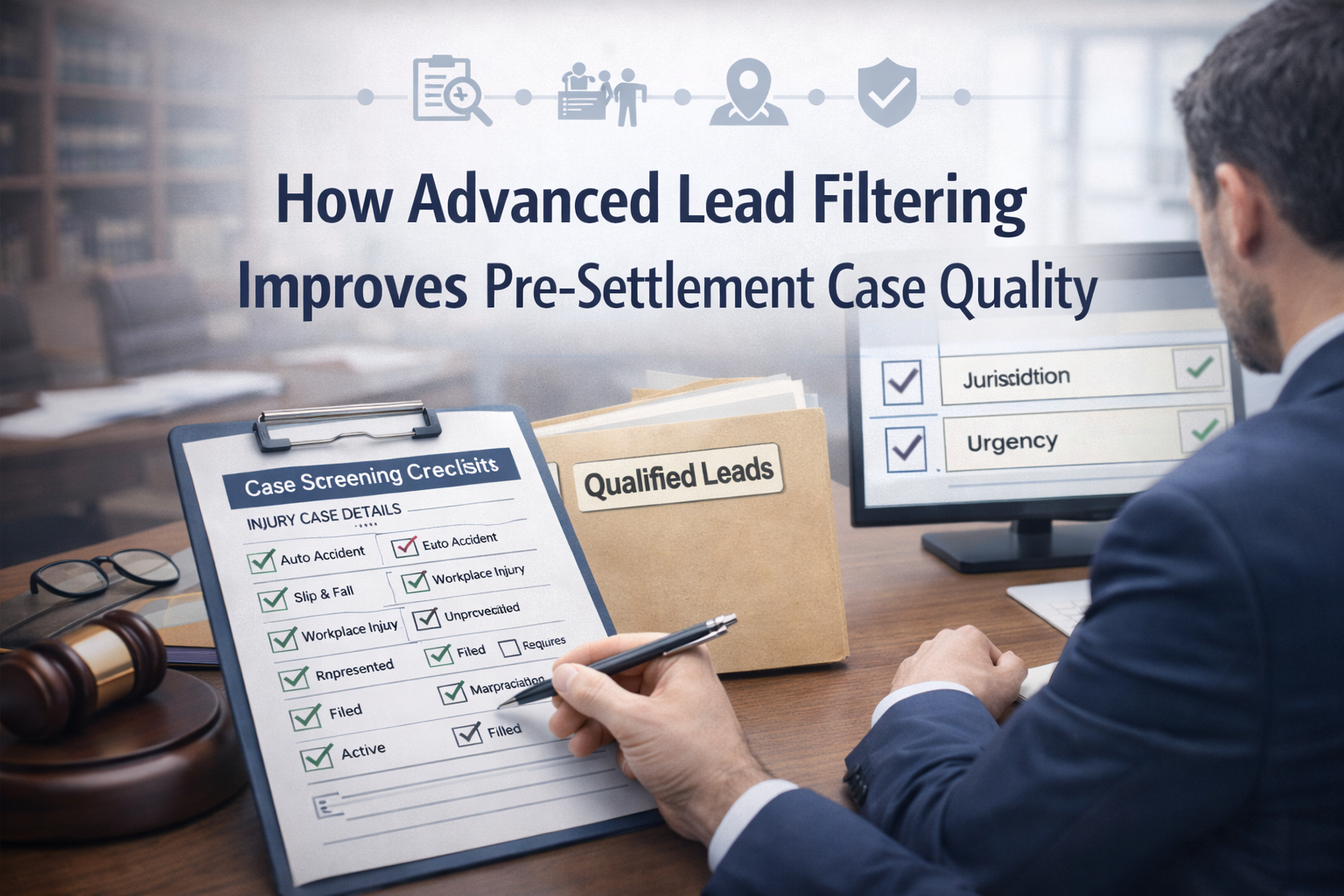
How Advanced Lead Filtering Improves Pre-Settlement Case Quality

How Advanced Lead Filtering Improves Pre-Settlement Case Quality

Estimated Reading Time: 6–7 minutes


⚖️ Introduction

In pre-settlement marketing, volume alone rarely leads to better outcomes.
What truly determines success is how precisely leads match your acceptance criteria.

This is where advanced lead filtering becomes critical.

Instead of reacting to every inquiry, attorneys and funding firms who use filtering receive cases that are closer to evaluation-ready, saving time, reducing friction, and improving overall efficiency.

This article explains how advanced filtering works and why it directly impacts pre-settlement case quality.


🎯 What Is Advanced Lead Filtering?

Advanced lead filtering is the process of pre-qualifying inquiries before delivery, based on criteria defined by the buyer—not the platform.

Unlike basic lead delivery (name + phone), filtering considers:

  • Case relevance
  • Readiness
  • Jurisdiction
  • Risk alignment

The goal is simple:
Send fewer leads, but better-matched ones.


⚙️ Why Unfiltered Leads Create Operational Noise

When leads arrive without filtering, buyers must:

  • Review ineligible cases
  • Reject mismatched claims
  • Spend staff time on non-viable prospects

This creates:

  • Slower response times
  • Lower team morale
  • Reduced conversion efficiency

Filtering removes noise before the lead reaches your inbox.


📊 Key Filters That Improve Pre-Settlement Lead Quality

Different firms handle different case profiles. Filtering ensures relevance from the start.

A usable filter set should include:

  • Injury type (auto accidents, slip & fall, workplace injuries, medical-related claims)
  • Case stage (early, ongoing, near settlement)
  • Attorney representation status (represented / unrepresented)
  • Jurisdiction & location
  • Urgency & intent level

These filters prevent ineligible or premature inquiries from reaching your team.


⚡ How Filtering Improves Internal Workflow

Advanced filtering doesn’t just improve lead quality—it improves operations.

  • Faster intake decisions
  • Better allocation of staff time
  • Clearer performance tracking
  • Reduced follow-up fatigue

Teams spend more time evaluating cases and less time rejecting them.


🧠 Filtering vs Manual Qualification

Without filtering:

  • You qualify after delivery
  • Time is wasted upfront
  • Conversion rates suffer

With filtering:

  • Qualification happens before delivery
  • Only relevant cases reach you
  • Evaluation becomes predictable

Filtering shifts effort upstream, where it belongs.


🏆 A More Sustainable Way to Scale

Scaling pre-settlement case acquisition isn’t about buying more leads—it’s about buying better-matched leads.

  • Increase consistency
  • Maintain quality standards
  • Scale without overwhelming intake teams
  • Keep operational control

Sustainable growth comes from control, not volume.


Final Thoughts

Advanced lead filtering transforms pre-settlement leads from random inquiries into structured case opportunities.

When buyers define what they want—and platforms respect those criteria—lead acquisition becomes measurable, efficient, and repeatable.

Instead of adjusting your process to fit incoming leads, consider a model where leads are filtered to fit your criteria first.

Looking for filtered, buyer-controlled pre-settlement leads instead of generic inquiries?
Explore how PreSettlementLeads.com focuses on buyer-defined filters, transparency, and relevance—so you receive inquiries aligned with how you actually evaluate cases.


⚖️ Better data. Better cases. Better results.

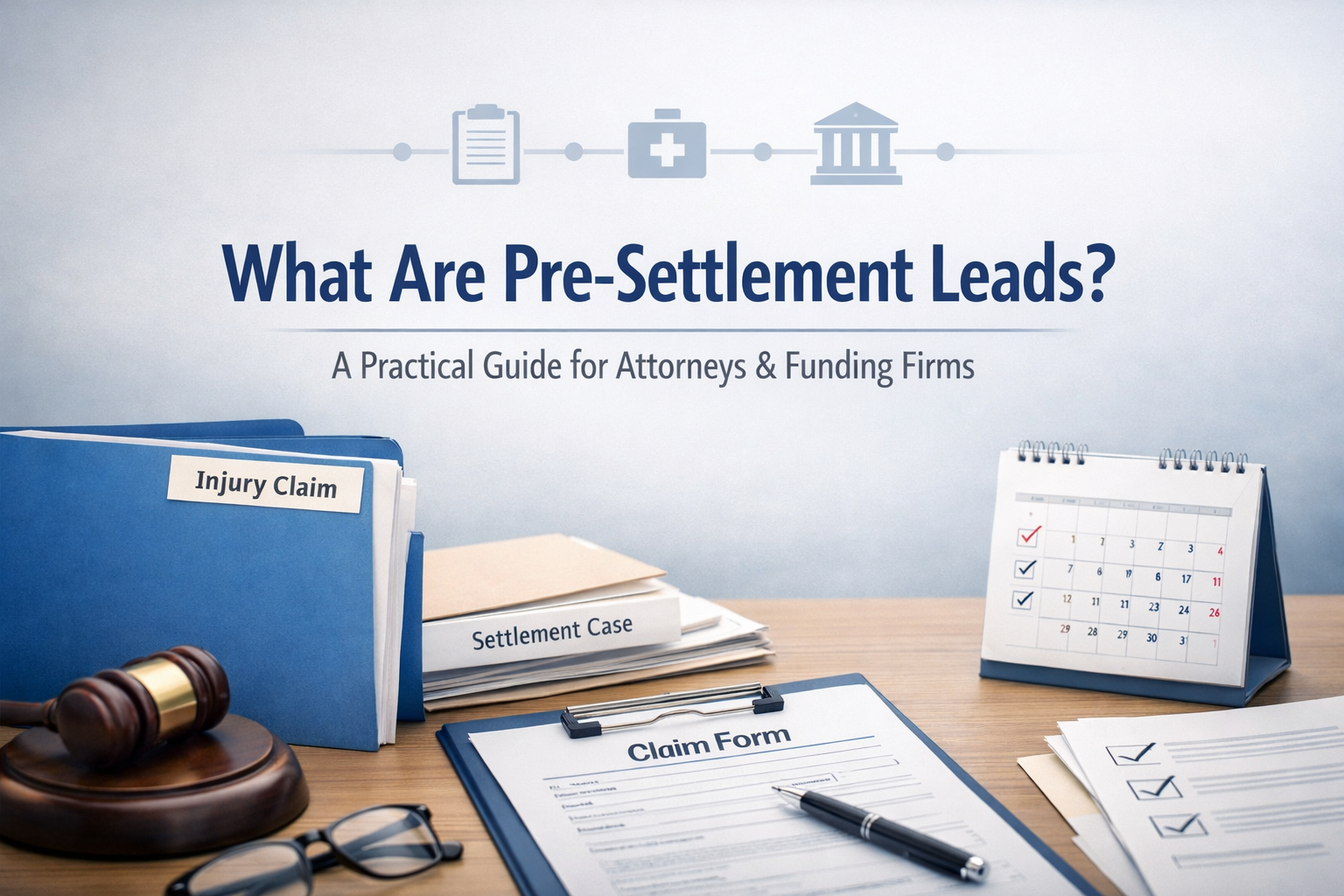
What Are Pre-Settlement Leads? A Complete Guide for Attorneys & Funding Firms

What Are Pre-Settlement Leads? A Complete Guide for Attorneys & Funding Firms

Estimated Reading Time: 6–7 minutes


⚖️ Introduction

Pre-settlement leads have become a critical growth channel for personal injury attorneys and pre-settlement funding companies. Yet, despite rising demand, many buyers struggle with poor-quality data, mismatched cases, and unrealistic expectations.

This guide explains what pre-settlement leads actually are, how they’re generated, and how professionals should evaluate them before investing.

If you’re serious about acquiring viable cases—not just names and phone numbers—this article will help you make informed decisions.


🎯 What Are Pre-Settlement Leads?

Pre-settlement leads are prospective claimants who:

  • Have an active or potential personal injury claim
  • Have not yet reached final settlement
  • Are seeking legal representation or financial relief while their case is ongoing

These individuals typically submit their details through online forms after researching:

  • Injury claims
  • Settlement timelines
  • Medical bill coverage
  • Case funding options

A lead becomes valuable only when it matches your acceptance criteria.


⚙️ Who Uses Pre-Settlement Leads?

Pre-settlement leads are primarily used by:

  • ⚖️ Personal Injury Attorneys
  • To acquire new cases
  • To supplement referrals
  • To scale intake volume predictably
  • 💼 Pre-Settlement Funding Companies
  • To evaluate funding eligibility
  • To expand deal flow
  • To maintain a steady pipeline of qualified prospects

Both groups rely on accurate case details, not generic inquiries.


📊 What Information Should a Quality Pre-Settlement Lead Include?

Not all leads are equal. A usable pre-settlement lead should include screening data, such as:

  • Type of injury (auto accident, slip & fall, workplace, etc.)
  • Accident date
  • Medical treatment status
  • Attorney representation (yes / no)
  • Case stage (early, ongoing, near settlement)
  • Location & jurisdiction
  • Urgency level

Leads without this context force buyers to waste time filtering manually.


⚡ How Are Pre-Settlement Leads Generated?

Legitimate pre-settlement leads are typically generated through:

  • Targeted search advertising
  • Educational landing pages
  • Claim evaluation forms
  • Consumer-initiated inquiries (not cold outreach)

The key difference lies in intent.

High-quality platforms attract users who are already researching legal or financial options—not people casually browsing.


🧠 Why Many Pre-Settlement Leads Fail

Many buyers become disappointed because they:

  • Purchase unfiltered or shared leads
  • Rely on vague intake forms
  • Expect guaranteed outcomes
  • Focus on price instead of qualification

A lead is not a funded deal or signed case.

It’s a starting point that requires proper screening, follow-up, and evaluation.


🏆 What Makes a Pre-Settlement Lead Valuable?

A valuable pre-settlement lead offers:

  • Relevance – Matches your criteria
  • Transparency – Clear data, no exaggeration
  • Buyer control – Filtering options
  • Exclusivity or clarity – You know how the lead is distributed

Quality comes from process, not promises.


Final Thoughts

Pre-settlement leads are a tool, not a shortcut.

When sourced ethically and filtered correctly, they can support consistent growth for attorneys and funding firms. When misunderstood or poorly implemented, they become an expense instead of an asset.

The difference lies in how leads are generated, filtered, and handled.

Looking for filtered, buyer-controlled pre-settlement leads instead of generic inquiries?
Explore how PreSettlementLeads.com allows professionals to choose exactly the case types they want—without inflated claims or forced packages.


⚖️ Better data. Better cases. Better results.

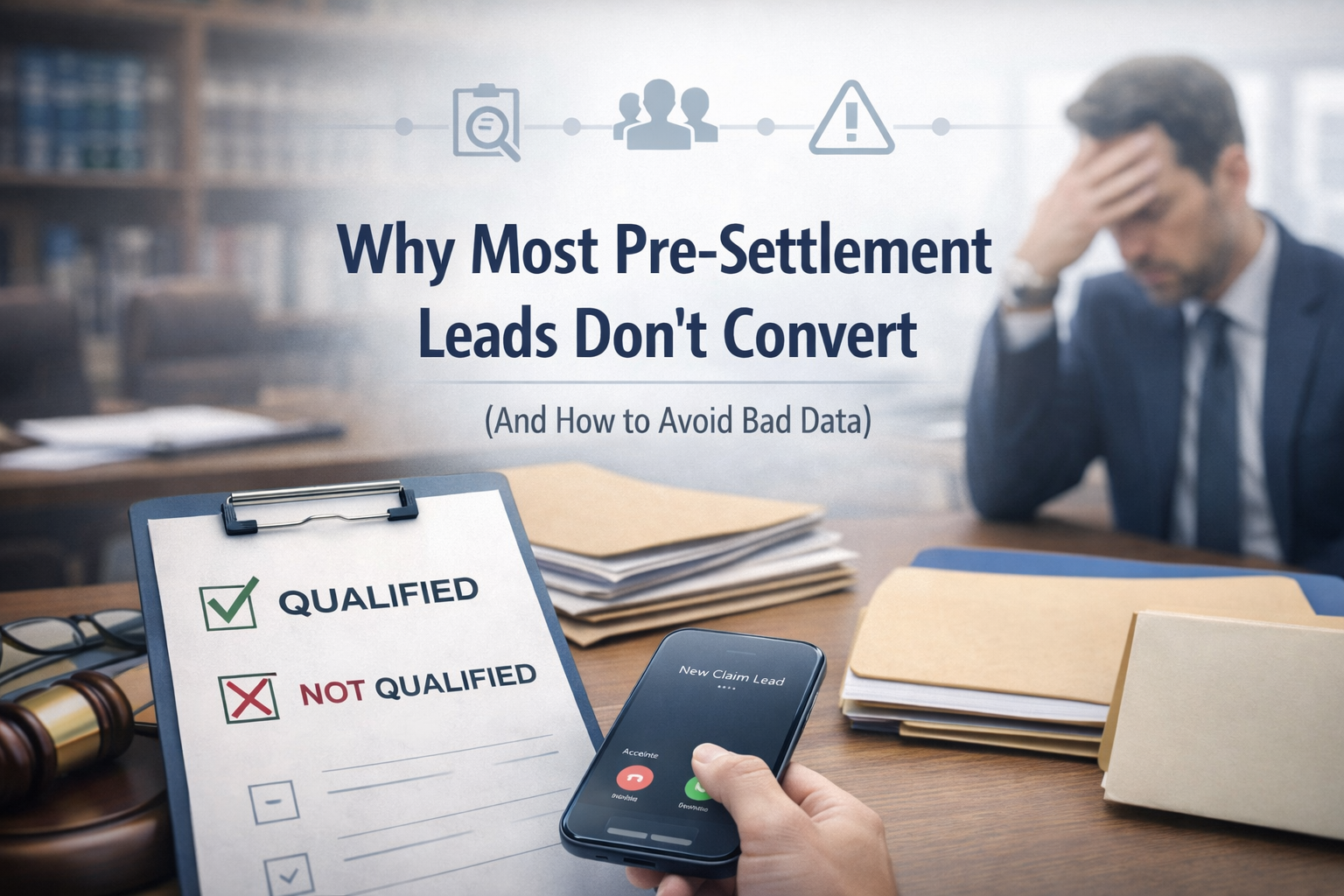
Why Most Pre-Settlement Leads Don’t Convert (And How to Avoid Bad Data)

Why Most Pre-Settlement Leads Don’t Convert (And How to Avoid Bad Data)

Estimated Reading Time: 6–7 minutes


⚖️ Introduction

Pre-settlement leads often come with high expectations — and just as often, disappointing results.

Many attorneys and pre-settlement funding firms invest heavily in leads, only to face low response rates, unqualified cases, or prospects that don’t meet their criteria.

When conversions fail, the issue is rarely the idea of pre-settlement leads themselves.

The real problem lies in how those leads are generated, filtered, and delivered.

Understanding these gaps is the first step toward turning inquiries into viable funding opportunities.


🎯 1. What Are Pre-Settlement Leads — Really?

A common myth is that pre-settlement leads should deliver:

  • Guaranteed cases
  • Immediate funding approvals
  • Fully vetted claimants

In reality, a pre-settlement lead is an inquiry — not a transaction.

Successful conversion depends on:

  • Accuracy of claimant information
  • Relevance to your funding criteria
  • Proper case evaluation
  • Speed and quality of follow-up

Without structure and screening, even high-intent inquiries break down.


⚙️ 2. Poor Intake Forms Create Poor Leads

Many lead providers rely on overly simple intake forms that collect only:

  • Name
  • Phone number
  • Generic “need help with settlement?” questions

This creates immediate problems.

Without detailed screening, buyers receive:

  • Ineligible or already settled cases
  • Claims outside their jurisdiction
  • Prospects who are too early in the process

A lack of intake depth guarantees wasted time and low conversions.


📊 3. Why Filtering Determines Conversion Success

One of the biggest conversion killers is forced volume.

When buyers cannot filter by:

  • Injury or case type
  • Case stage
  • Attorney representation status
  • Urgency and readiness

They are forced to manually reject leads after delivery.

This isn’t a lead-quality issue — it’s a filtering failure.

Advanced filters give professionals control and predictability.


⚡ 4. Shared & Oversold Leads Kill Trust

When the same pre-settlement lead is sent to multiple buyers:

  • Response speed becomes a race
  • Claimants receive conflicting calls
  • Trust drops instantly

Even strong prospects disengage when overwhelmed.

Without clear exclusivity or distribution rules, conversion rates suffer — no matter how good the lead looks on paper.


🧠 5. Timing Matters More Than Most Buyers Realize

Many pre-settlement leads fail simply because of timing.

Common issues include:

  • Claimants still early in medical treatment
  • Incomplete documentation
  • Cases not yet ready for evaluation

Without filtering by case stage, even legitimate claims won’t convert.

Timing is not optional — it’s critical.


🏆 Conclusion

Most pre-settlement leads don’t fail because the market is broken.

They fail because data quality, filtering, and buyer control are ignored.

When professionals focus on:

  • What leads they receive
  • When they receive them
  • And why those leads match their criteria

Pre-settlement leads become a measurable acquisition channel — not a gamble.


Tired of wasting time on poorly screened inquiries?
Learn how PreSettlementLeads.com focuses on filtering, transparency, and buyer control — so you receive leads that fit your criteria, not just volume.


⚖️ Better data. Better cases. Better results.

SIMILAR ARTICLES