
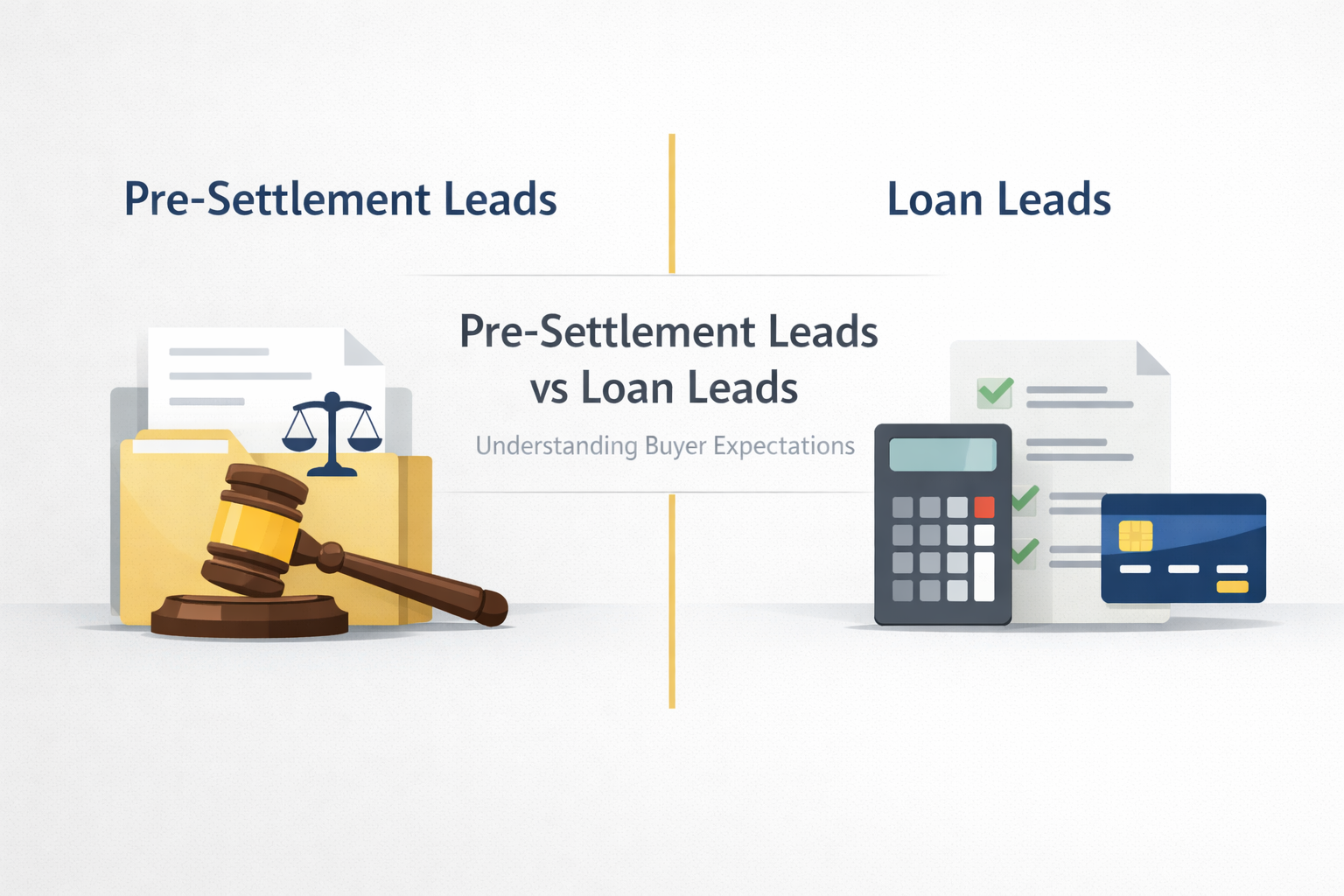
Pre-Settlement Leads vs Loan Leads: Why They Are Not the Same

Pre-Settlement Leads vs Loan Leads: Why They Are Not the Same

Estimated Reading Time: 6–7 minutes


Introduction

Many funding companies entering online lead buying assume pre-settlement leads behave like traditional loan or finance leads. That assumption often leads to frustration, mismatched expectations, and disappointing ROI.

In reality, pre-settlement leads are fundamentally different—in how they are generated, qualified, verified, and converted. Understanding these differences is critical for evaluating lead quality correctly and scaling profitably.


What Are Pre-Settlement Leads?

Pre-settlement leads are inquiries from plaintiffs with active legal cases who are seeking financial relief while their lawsuit is still pending.

Unlike loan leads, these prospects are:

  • Case-dependent, not credit-dependent
  • Subject to legal and liability review
  • Required to involve their attorney
  • Not guaranteed to qualify after evaluation

A pre-settlement lead represents an opportunity for review—not an approved funding decision.


How Loan Leads Work (And Why Expectations Differ)

Traditional loan leads typically operate in a very different environment.

Loan leads are usually:

  • Credit-driven and income-based
  • Processed through automated decision systems
  • High-speed and high-volume

As a result, many loan buyers expect:

  • Same-day or instant approvals
  • Minimal third-party involvement
  • Clear and predictable qualification rules

Pre-settlement leads do not follow this model—and treating them the same way leads to incorrect conclusions about quality.


Pre-Settlement Leads vs Loan Leads

Aspect Pre-Settlement Leads Loan Leads
Qualification Basis Case strength & liability Credit & income
Attorney Involvement Mandatory None
Approval Speed Variable Fast
Conversion Timeline Longer Short
Guaranteed Outcome No Often yes
Volume Consistency Case-driven Traffic-driven

Why Pre-Settlement Leads Cannot Be “Instant”

Even high-quality pre-settlement leads require several verification steps:

  • Attorney contact and consent
  • Case documentation review
  • Liability and risk assessment
  • Internal funding policy checks

This means:

  • Real-time lead delivery does not equal instant funding
  • Some leads will be declined after proper review
  • Conversion depends heavily on follow-up and legal coordination

These delays are normal characteristics of the funding process—not indicators of poor lead quality.


What Makes a Pre-Settlement Lead Valuable?

A strong pre-settlement lead typically includes:

  • Confirmation of an active legal case
  • Relevant case type (auto accident, PI, etc.)
  • A clear and legitimate funding need
  • Willingness to involve their attorney
  • Accurate and reachable contact information

However, no lead provider can guarantee funding approval—just as no advertising platform can guarantee a sale.


How to Evaluate ROI Correctly

Successful funding companies measure performance using:

  • Cost per funded case (not cost per lead)
  • Approval ratios over time
  • Follow-up efficiency
  • Attorney responsiveness

Judging pre-settlement leads by speed alone—especially when compared to loan leads—leads to flawed ROI analysis.


Final Takeaway

Pre-settlement leads are not loan leads, and they should never be treated as such.

Funding companies that understand:

  • Legal timelines
  • Case-based risk evaluation
  • Attorney dependency

are the ones that achieve consistent, sustainable ROI.

If you’re buying pre-settlement leads, success comes from alignment—not automation.
What Are Pre-Settlement Leads? A Complete Guide for Attorneys & Funding Firms

What Are Pre-Settlement Leads? A Complete Guide for Attorneys & Funding Firms

Estimated Reading Time: 6–7 minutes


⚖️ Introduction

Pre-settlement leads have become a critical growth channel for personal injury attorneys and pre-settlement funding companies. Yet, despite rising demand, many buyers struggle with poor-quality data, mismatched cases, and unrealistic expectations.

This guide explains what pre-settlement leads actually are, how they’re generated, and how professionals should evaluate them before investing.

If you’re serious about acquiring viable cases—not just names and phone numbers—this article will help you make informed decisions.


🎯 What Are Pre-Settlement Leads?

Pre-settlement leads are prospective claimants who:

  • Have an active or potential personal injury claim
  • Have not yet reached final settlement
  • Are seeking legal representation or financial relief while their case is ongoing

These individuals typically submit their details through online forms after researching:

  • Injury claims
  • Settlement timelines
  • Medical bill coverage
  • Case funding options

A lead becomes valuable only when it matches your acceptance criteria.


⚙️ Who Uses Pre-Settlement Leads?

Pre-settlement leads are primarily used by:

  • ⚖️ Personal Injury Attorneys
  • To acquire new cases
  • To supplement referrals
  • To scale intake volume predictably
  • 💼 Pre-Settlement Funding Companies
  • To evaluate funding eligibility
  • To expand deal flow
  • To maintain a steady pipeline of qualified prospects

Both groups rely on accurate case details, not generic inquiries.


📊 What Information Should a Quality Pre-Settlement Lead Include?

Not all leads are equal. A usable pre-settlement lead should include screening data, such as:

  • Type of injury (auto accident, slip & fall, workplace, etc.)
  • Accident date
  • Medical treatment status
  • Attorney representation (yes / no)
  • Case stage (early, ongoing, near settlement)
  • Location & jurisdiction
  • Urgency level

Leads without this context force buyers to waste time filtering manually.


⚡ How Are Pre-Settlement Leads Generated?

Legitimate pre-settlement leads are typically generated through:

  • Targeted search advertising
  • Educational landing pages
  • Claim evaluation forms
  • Consumer-initiated inquiries (not cold outreach)

The key difference lies in intent.

High-quality platforms attract users who are already researching legal or financial options—not people casually browsing.


🧠 Why Many Pre-Settlement Leads Fail

Many buyers become disappointed because they:

  • Purchase unfiltered or shared leads
  • Rely on vague intake forms
  • Expect guaranteed outcomes
  • Focus on price instead of qualification

A lead is not a funded deal or signed case.

It’s a starting point that requires proper screening, follow-up, and evaluation.


🏆 What Makes a Pre-Settlement Lead Valuable?

A valuable pre-settlement lead offers:

  • Relevance – Matches your criteria
  • Transparency – Clear data, no exaggeration
  • Buyer control – Filtering options
  • Exclusivity or clarity – You know how the lead is distributed

Quality comes from process, not promises.


Final Thoughts

Pre-settlement leads are a tool, not a shortcut.

When sourced ethically and filtered correctly, they can support consistent growth for attorneys and funding firms. When misunderstood or poorly implemented, they become an expense instead of an asset.

The difference lies in how leads are generated, filtered, and handled.

Looking for filtered, buyer-controlled pre-settlement leads instead of generic inquiries?
Explore how PreSettlementLeads.com allows professionals to choose exactly the case types they want—without inflated claims or forced packages.


⚖️ Better data. Better cases. Better results.