Exclusive vs Shared Pre-Settlement Leads: Which One Actually Delivers ROI?

Exclusive vs Shared Pre-Settlement Leads: Which One Actually Delivers ROI?

Estimated Reading Time: 6–7 minutes


Introduction

One of the most common questions attorneys and pre-settlement funding firms ask is simple:
Should we buy exclusive leads or shared leads?
The answer isn’t about hype or pricing—it’s about process, expectations, and return on effort. This article breaks down how exclusive and shared pre-settlement leads actually work, where each model fits, and which one tends to deliver better ROI over time.


What Are Shared Pre-Settlement Leads?

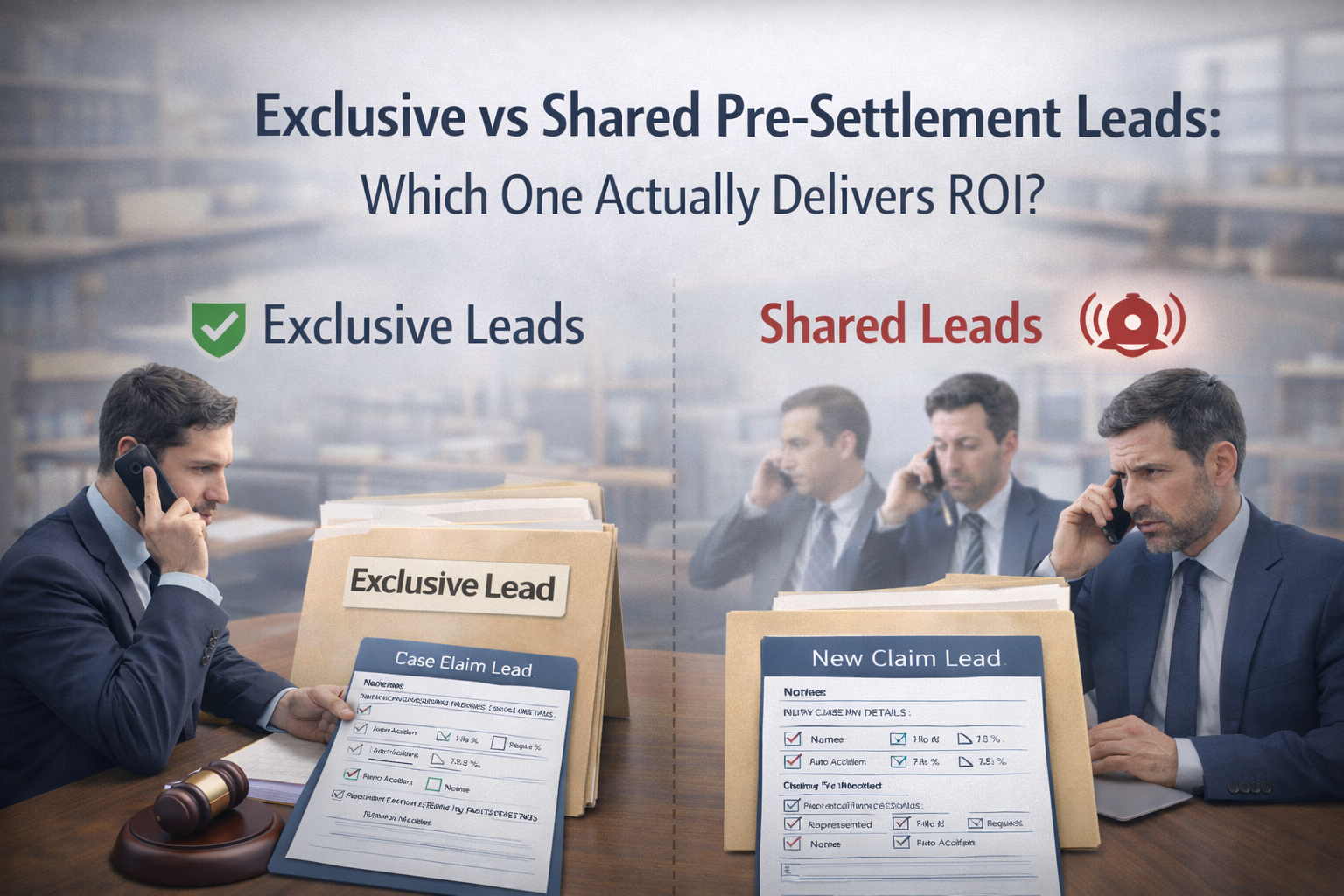
Shared leads are inquiries delivered to multiple buyers at the same time.
How shared leads typically work:

  • One claimant submits an inquiry
  • The same details are sent to several firms
  • Buyers compete on response time and follow-up

Common advantages:

  • Lower upfront cost
  • Higher volume availability

Common challenges:

  • Speed becomes more important than evaluation
  • Claimants receive multiple calls
  • Trust drops quickly
  • Qualification quality often suffers

Shared leads turn intake into a race, not a review process.


What Are Exclusive Pre-Settlement Leads?

Exclusive leads are delivered to one buyer only, based on predefined criteria.
How exclusivity works:

  • Buyer selects filters (case type, stage, location, etc.)
  • Only matching inquiries are delivered
  • No competing outreach from other buyers

Common advantages:

  • Clear ownership of the inquiry
  • Better claimant experience
  • More time for proper evaluation
  • Predictable intake workflow

Exclusivity supports deliberate case assessment, not rushed contact.


The ROI Difference Isn’t Just About Cost

Many buyers compare exclusive vs shared leads purely on price.
That comparison is incomplete.
ROI is influenced by:

  • Staff time spent per lead
  • Follow-up efficiency
  • Case relevance
  • Claimant engagement

A cheaper shared lead that consumes hours of staff time can cost more than a higher-priced exclusive lead that fits immediately.


Where Shared Leads Can Make Sense

Shared leads may be suitable when:

  • You have a high-capacity intake team
  • Speed-based outreach is part of your model
  • You are testing a new market
  • Volume matters more than precision

They work best when expectations are realistic and processes are optimized for competition.


Where Exclusive Leads Perform Better

Exclusive leads tend to perform better when:

  • Case evaluation requires documentation review
  • Jurisdiction or criteria are strict
  • You value claimant experience
  • Intake teams prioritize quality over speed

For most pre-settlement evaluations, control beats competition.


The Hidden Cost of Over-Competition

When claimants receive multiple calls:

  • Confusion increases
  • Responsiveness drops
  • Trust erodes

This affects everyone involved—not just one buyer.
Exclusivity reduces noise and creates a more professional intake experience.


Choosing the Right Model for Your Operation

Instead of asking:

  • “Which leads are cheaper?”

Ask:

  • How much time does my team spend per lead?
  • How many leads reach evaluation-ready stage?
  • How predictable is my intake workflow?
  • How important is claimant experience?

The answers usually point toward better-aligned lead delivery, not just more leads.


Final Thoughts

Exclusive and shared pre-settlement leads serve different purposes—but they don’t deliver the same results.
For firms focused on efficiency, clarity, and sustainable growth, exclusivity often provides stronger ROI—not because it guarantees outcomes, but because it supports better process.


Explore a More Controlled Approach to Pre-Settlement Leads

Instead of competing for the same inquiry, consider a model where lead delivery aligns with your evaluation criteria from the start.
PreSettlementLeads.com focuses on buyer-defined filters and transparent distribution—so you know exactly how and why a lead reaches you.

⚖️ Better control. Better evaluation. Better ROI.
How Advanced Lead Filtering Improves Pre-Settlement Case Quality

How Advanced Lead Filtering Improves Pre-Settlement Case Quality

Estimated Reading Time: 6–7 minutes


⚖️ Introduction

In pre-settlement marketing, volume alone rarely leads to better outcomes.
What truly determines success is how precisely leads match your acceptance criteria.

This is where advanced lead filtering becomes critical.

Instead of reacting to every inquiry, attorneys and funding firms who use filtering receive cases that are closer to evaluation-ready, saving time, reducing friction, and improving overall efficiency.

This article explains how advanced filtering works and why it directly impacts pre-settlement case quality.


🎯 What Is Advanced Lead Filtering?

Advanced lead filtering is the process of pre-qualifying inquiries before delivery, based on criteria defined by the buyer—not the platform.

Unlike basic lead delivery (name + phone), filtering considers:

  • Case relevance
  • Readiness
  • Jurisdiction
  • Risk alignment

The goal is simple:
Send fewer leads, but better-matched ones.


⚙️ Why Unfiltered Leads Create Operational Noise

When leads arrive without filtering, buyers must:

  • Review ineligible cases
  • Reject mismatched claims
  • Spend staff time on non-viable prospects

This creates:

  • Slower response times
  • Lower team morale
  • Reduced conversion efficiency

Filtering removes noise before the lead reaches your inbox.


📊 Key Filters That Improve Pre-Settlement Lead Quality

Different firms handle different case profiles. Filtering ensures relevance from the start.

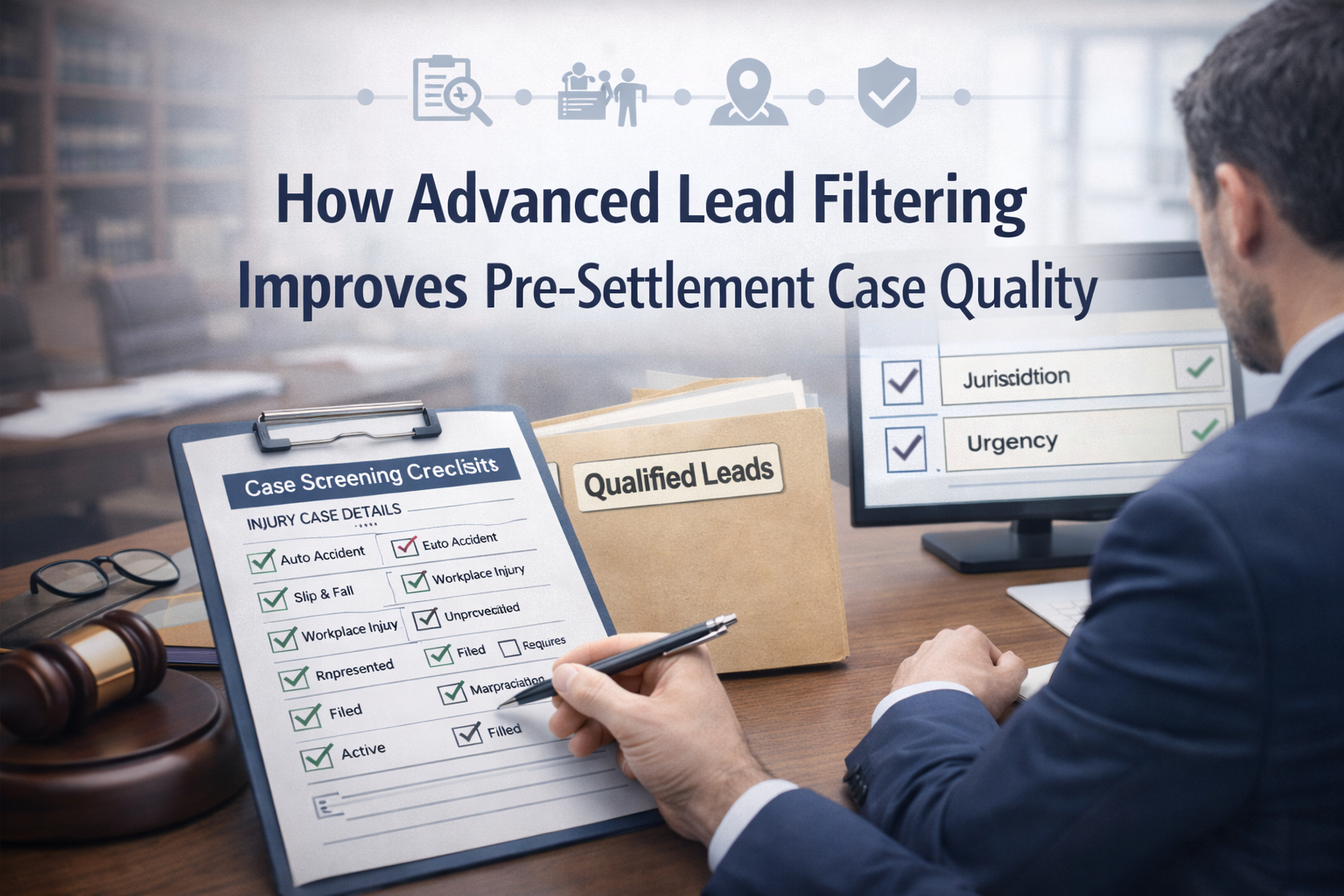
A usable filter set should include:

  • Injury type (auto accidents, slip & fall, workplace injuries, medical-related claims)
  • Case stage (early, ongoing, near settlement)
  • Attorney representation status (represented / unrepresented)
  • Jurisdiction & location
  • Urgency & intent level

These filters prevent ineligible or premature inquiries from reaching your team.


⚡ How Filtering Improves Internal Workflow

Advanced filtering doesn’t just improve lead quality—it improves operations.

  • Faster intake decisions
  • Better allocation of staff time
  • Clearer performance tracking
  • Reduced follow-up fatigue

Teams spend more time evaluating cases and less time rejecting them.


🧠 Filtering vs Manual Qualification

Without filtering:

  • You qualify after delivery
  • Time is wasted upfront
  • Conversion rates suffer

With filtering:

  • Qualification happens before delivery
  • Only relevant cases reach you
  • Evaluation becomes predictable

Filtering shifts effort upstream, where it belongs.


🏆 A More Sustainable Way to Scale

Scaling pre-settlement case acquisition isn’t about buying more leads—it’s about buying better-matched leads.

  • Increase consistency
  • Maintain quality standards
  • Scale without overwhelming intake teams
  • Keep operational control

Sustainable growth comes from control, not volume.


Final Thoughts

Advanced lead filtering transforms pre-settlement leads from random inquiries into structured case opportunities.

When buyers define what they want—and platforms respect those criteria—lead acquisition becomes measurable, efficient, and repeatable.

Instead of adjusting your process to fit incoming leads, consider a model where leads are filtered to fit your criteria first.

Looking for filtered, buyer-controlled pre-settlement leads instead of generic inquiries?
Explore how PreSettlementLeads.com focuses on buyer-defined filters, transparency, and relevance—so you receive inquiries aligned with how you actually evaluate cases.


⚖️ Better data. Better cases. Better results.

What Are Pre-Settlement Leads? A Complete Guide for Attorneys & Funding Firms

What Are Pre-Settlement Leads? A Complete Guide for Attorneys & Funding Firms

Estimated Reading Time: 6–7 minutes


⚖️ Introduction

Pre-settlement leads have become a critical growth channel for personal injury attorneys and pre-settlement funding companies. Yet, despite rising demand, many buyers struggle with poor-quality data, mismatched cases, and unrealistic expectations.

This guide explains what pre-settlement leads actually are, how they’re generated, and how professionals should evaluate them before investing.

If you’re serious about acquiring viable cases—not just names and phone numbers—this article will help you make informed decisions.


🎯 What Are Pre-Settlement Leads?

Pre-settlement leads are prospective claimants who:

  • Have an active or potential personal injury claim
  • Have not yet reached final settlement
  • Are seeking legal representation or financial relief while their case is ongoing

These individuals typically submit their details through online forms after researching:

  • Injury claims
  • Settlement timelines
  • Medical bill coverage
  • Case funding options

A lead becomes valuable only when it matches your acceptance criteria.


⚙️ Who Uses Pre-Settlement Leads?

Pre-settlement leads are primarily used by:

  • ⚖️ Personal Injury Attorneys
  • To acquire new cases
  • To supplement referrals
  • To scale intake volume predictably
  • 💼 Pre-Settlement Funding Companies
  • To evaluate funding eligibility
  • To expand deal flow
  • To maintain a steady pipeline of qualified prospects

Both groups rely on accurate case details, not generic inquiries.


📊 What Information Should a Quality Pre-Settlement Lead Include?

Not all leads are equal. A usable pre-settlement lead should include screening data, such as:

  • Type of injury (auto accident, slip & fall, workplace, etc.)
  • Accident date
  • Medical treatment status
  • Attorney representation (yes / no)
  • Case stage (early, ongoing, near settlement)
  • Location & jurisdiction
  • Urgency level

Leads without this context force buyers to waste time filtering manually.


⚡ How Are Pre-Settlement Leads Generated?

Legitimate pre-settlement leads are typically generated through:

  • Targeted search advertising
  • Educational landing pages
  • Claim evaluation forms
  • Consumer-initiated inquiries (not cold outreach)

The key difference lies in intent.

High-quality platforms attract users who are already researching legal or financial options—not people casually browsing.


🧠 Why Many Pre-Settlement Leads Fail

Many buyers become disappointed because they:

  • Purchase unfiltered or shared leads
  • Rely on vague intake forms
  • Expect guaranteed outcomes
  • Focus on price instead of qualification

A lead is not a funded deal or signed case.

It’s a starting point that requires proper screening, follow-up, and evaluation.


🏆 What Makes a Pre-Settlement Lead Valuable?

A valuable pre-settlement lead offers:

  • Relevance – Matches your criteria
  • Transparency – Clear data, no exaggeration
  • Buyer control – Filtering options
  • Exclusivity or clarity – You know how the lead is distributed

Quality comes from process, not promises.


Final Thoughts

Pre-settlement leads are a tool, not a shortcut.

When sourced ethically and filtered correctly, they can support consistent growth for attorneys and funding firms. When misunderstood or poorly implemented, they become an expense instead of an asset.

The difference lies in how leads are generated, filtered, and handled.

Looking for filtered, buyer-controlled pre-settlement leads instead of generic inquiries?
Explore how PreSettlementLeads.com allows professionals to choose exactly the case types they want—without inflated claims or forced packages.


⚖️ Better data. Better cases. Better results.

SIMILAR ARTICLES

Why Most Pre-Settlement Leads Don’t Convert (And How to Avoid Bad Data)

Why Most Pre-Settlement Leads Don’t Convert (And How to Avoid Bad Data)

Estimated Reading Time: 6–7 minutes


⚖️ Introduction

Pre-settlement leads often come with high expectations — and just as often, disappointing results.

Many attorneys and pre-settlement funding firms invest heavily in leads, only to face low response rates, unqualified cases, or prospects that don’t meet their criteria.

When conversions fail, the issue is rarely the idea of pre-settlement leads themselves.

The real problem lies in how those leads are generated, filtered, and delivered.

Understanding these gaps is the first step toward turning inquiries into viable funding opportunities.


🎯 1. What Are Pre-Settlement Leads — Really?

A common myth is that pre-settlement leads should deliver:

  • Guaranteed cases
  • Immediate funding approvals
  • Fully vetted claimants

In reality, a pre-settlement lead is an inquiry — not a transaction.

Successful conversion depends on:

  • Accuracy of claimant information
  • Relevance to your funding criteria
  • Proper case evaluation
  • Speed and quality of follow-up

Without structure and screening, even high-intent inquiries break down.


⚙️ 2. Poor Intake Forms Create Poor Leads

Many lead providers rely on overly simple intake forms that collect only:

  • Name
  • Phone number
  • Generic “need help with settlement?” questions

This creates immediate problems.

Without detailed screening, buyers receive:

  • Ineligible or already settled cases
  • Claims outside their jurisdiction
  • Prospects who are too early in the process

A lack of intake depth guarantees wasted time and low conversions.


📊 3. Why Filtering Determines Conversion Success

One of the biggest conversion killers is forced volume.

When buyers cannot filter by:

  • Injury or case type
  • Case stage
  • Attorney representation status
  • Urgency and readiness

They are forced to manually reject leads after delivery.

This isn’t a lead-quality issue — it’s a filtering failure.

Advanced filters give professionals control and predictability.


⚡ 4. Shared & Oversold Leads Kill Trust

When the same pre-settlement lead is sent to multiple buyers:

  • Response speed becomes a race
  • Claimants receive conflicting calls
  • Trust drops instantly

Even strong prospects disengage when overwhelmed.

Without clear exclusivity or distribution rules, conversion rates suffer — no matter how good the lead looks on paper.


🧠 5. Timing Matters More Than Most Buyers Realize

Many pre-settlement leads fail simply because of timing.

Common issues include:

  • Claimants still early in medical treatment
  • Incomplete documentation
  • Cases not yet ready for evaluation

Without filtering by case stage, even legitimate claims won’t convert.

Timing is not optional — it’s critical.


🏆 Conclusion

Most pre-settlement leads don’t fail because the market is broken.

They fail because data quality, filtering, and buyer control are ignored.

When professionals focus on:

  • What leads they receive
  • When they receive them
  • And why those leads match their criteria

Pre-settlement leads become a measurable acquisition channel — not a gamble.


Tired of wasting time on poorly screened inquiries?
Learn how PreSettlementLeads.com focuses on filtering, transparency, and buyer control — so you receive leads that fit your criteria, not just volume.


⚖️ Better data. Better cases. Better results.

SIMILAR ARTICLES