Estimated Reading Time: 6–7 minutes
Introduction
One of the most common questions attorneys and pre-settlement funding firms ask is simple:
Should we buy exclusive leads or shared leads?
The answer isn’t about hype or pricing—it’s about process, expectations, and return on effort. This article breaks down how exclusive and shared pre-settlement leads actually work, where each model fits, and which one tends to deliver better ROI over time.
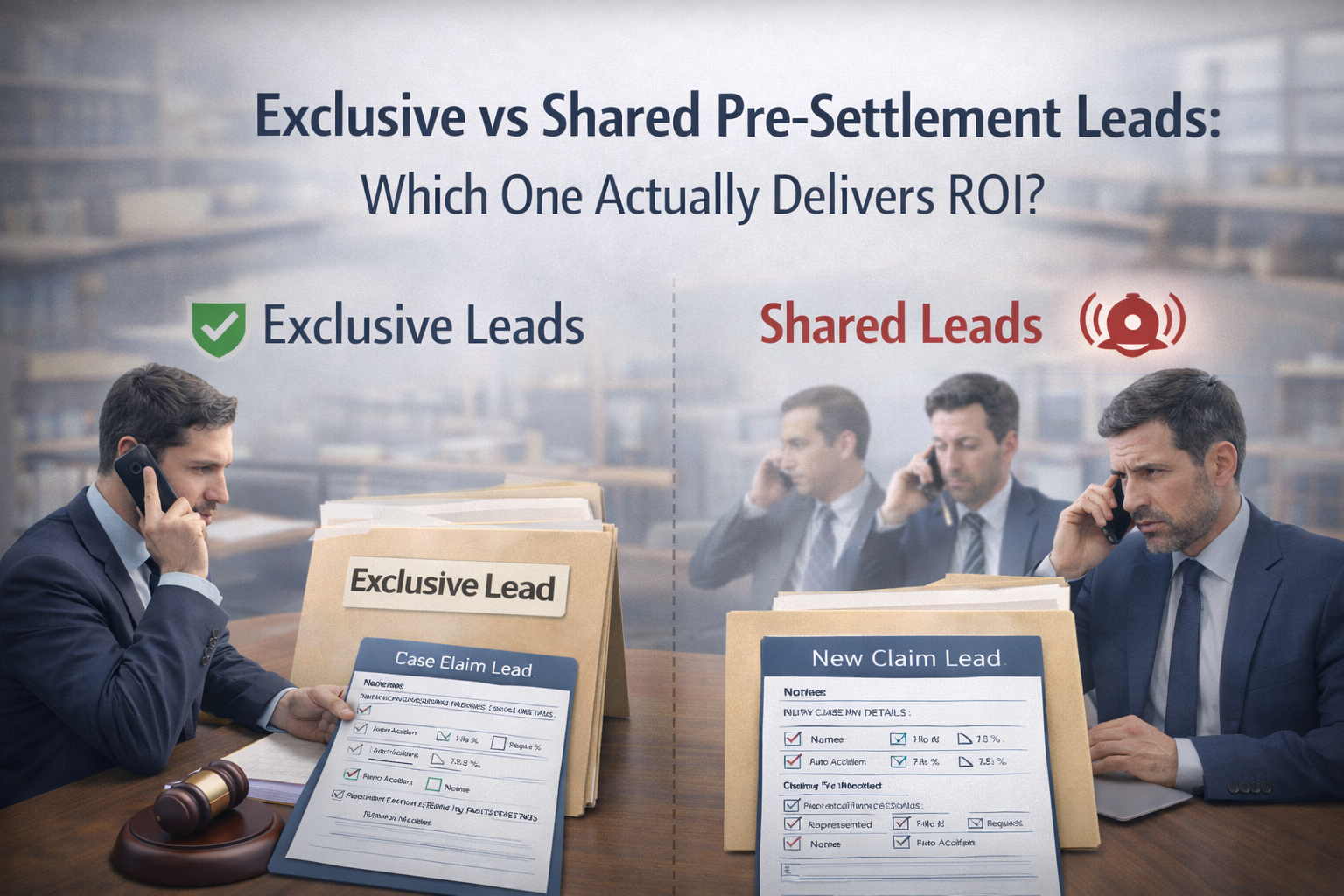
What Are Shared Pre-Settlement Leads?
Shared leads are inquiries delivered to multiple buyers at the same time.
How shared leads typically work:
- One claimant submits an inquiry
- The same details are sent to several firms
- Buyers compete on response time and follow-up
Common advantages:
- Lower upfront cost
- Higher volume availability
Common challenges:
- Speed becomes more important than evaluation
- Claimants receive multiple calls
- Trust drops quickly
- Qualification quality often suffers
Shared leads turn intake into a race, not a review process.
What Are Exclusive Pre-Settlement Leads?
Exclusive leads are delivered to one buyer only, based on predefined criteria.
How exclusivity works:
- Buyer selects filters (case type, stage, location, etc.)
- Only matching inquiries are delivered
- No competing outreach from other buyers
Common advantages:
- Clear ownership of the inquiry
- Better claimant experience
- More time for proper evaluation
- Predictable intake workflow
Exclusivity supports deliberate case assessment, not rushed contact.
The ROI Difference Isn’t Just About Cost
Many buyers compare exclusive vs shared leads purely on price.
That comparison is incomplete.
ROI is influenced by:
- Staff time spent per lead
- Follow-up efficiency
- Case relevance
- Claimant engagement
A cheaper shared lead that consumes hours of staff time can cost more than a higher-priced exclusive lead that fits immediately.
Where Shared Leads Can Make Sense
Shared leads may be suitable when:
- You have a high-capacity intake team
- Speed-based outreach is part of your model
- You are testing a new market
- Volume matters more than precision
They work best when expectations are realistic and processes are optimized for competition.
Where Exclusive Leads Perform Better
Exclusive leads tend to perform better when:
- Case evaluation requires documentation review
- Jurisdiction or criteria are strict
- You value claimant experience
- Intake teams prioritize quality over speed
For most pre-settlement evaluations, control beats competition.
The Hidden Cost of Over-Competition
When claimants receive multiple calls:
- Confusion increases
- Responsiveness drops
- Trust erodes
This affects everyone involved—not just one buyer.
Exclusivity reduces noise and creates a more professional intake experience.
Choosing the Right Model for Your Operation
Instead of asking:
- “Which leads are cheaper?”
Ask:
- How much time does my team spend per lead?
- How many leads reach evaluation-ready stage?
- How predictable is my intake workflow?
- How important is claimant experience?
The answers usually point toward better-aligned lead delivery, not just more leads.
Final Thoughts
Exclusive and shared pre-settlement leads serve different purposes—but they don’t deliver the same results.
For firms focused on efficiency, clarity, and sustainable growth, exclusivity often provides stronger ROI—not because it guarantees outcomes, but because it supports better process.
Explore a More Controlled Approach to Pre-Settlement Leads
Instead of competing for the same inquiry, consider a model where lead delivery aligns with your evaluation criteria from the start.
PreSettlementLeads.com focuses on buyer-defined filters and transparent distribution—so you know exactly how and why a lead reaches you.
⚖️ Better control. Better evaluation. Better ROI.